
Chapter 2 of the book begins with the assertion that Nike, despite its prominence, is actually not that strong a brand these days, and gives financial evidence and leadership-change history as of late 2024, when that chapter was initially written. Readers will naturally wonder what the situation is today, as of late 2026. So here is an update, beginning with this striking graphic from a recent Bloomberg article (Nov 16, 2026, It’s Break-Up Time for Nike and Kim Kardashian, by Andrea Felsted):
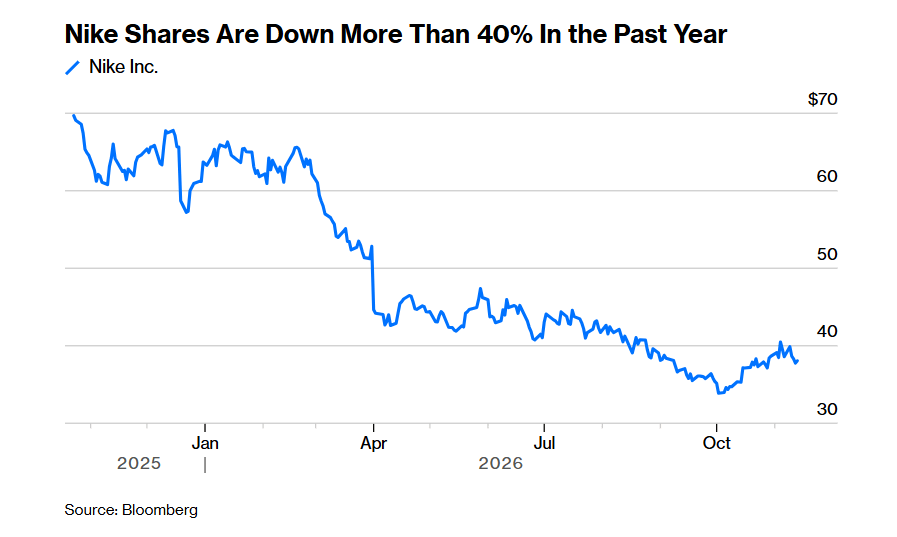
Besides arguing that the recent NikeSkims smoothing and sculpting apparel line with Kim Kardashian is not one in which Nike should invest more time and money, the article strongly recommends that Nike CEO Elliott Hill (who was brought in in October 2024 to change the brand’s strategy) should continue to focus on Nike’s “struggling” “sport offense” strategy intended to strengthen Nike’s products’ ability to make its clothing and footwear buyers “run faster, play harder and lift heavier.”
Nike’s third-quarter 2026 financial results were met with negative reviews and downgrades by many. Barrons magazine (https://www.barrons.com/articles/nike-stock-price-downgrade-rating-42c113f3) reported analyst downgrades on its stock because of concerns about the company’s lack of innovation, not much excitement with its new product launches, a decline in North American wholesale revenue (in part due to ill-advised retail distribution changes), and weakening consumer demand in China. At that time in September 2026, Nike’s shares had fallen 44% this year having lost more than 50% of their value over the last 12 months, while the S&P 500 had climbed 13%. A Wall Street Journal (WSJ) article on October 1, 2026 (https://www.wsj.com/business/earnings/nike-projects-sales-decline-this-year-after-lower-first-quarter-revenue-3b845fa0) reported that Nike announced plans to shrink its operations and cut jobs to improve its financial results. It added that a key USA retailer, Dick’s Sporting Goods, was finding that sales of some of Nike’s classic shoes — such as Air Force 1 sneakers — had slowed. Nike’s own sales forecasts expected these sales declines to continue at least through May 2027.
China is the company’s second-largest market, where Nike’s revenue has declined almost 30% from its peak five years ago. (More commentary on Nike’s China problems is at: https://www.wsj.com/business/retail/the-nike-lifer-driving-a-high-stakes-turnaround-in-china-b7c9842e). While there are many reasons for this decline (including changes in retail distribution), one of them is the increasing perception among Chinese buyers that the brand’s quality and value now isn’t as good as Chinese rivals. “Plenty of domestic brands now offer superior technology at a fraction of the cost,” is one quote in this WSJ article on October 1, 2026. Chinese competitors like Anta (which also owns the Fila and Descente brands in China) and Li-Ning are now releasing new sneakers, with better technology and more-local style, at twice the speed of Nike — and at half the price.
There are also complaints in this WSJ October 1 article that Nike’s advertising in China uses messaging that is less relevant culturally, emphasizing winning and competitiveness while younger Chinese engage in sports just to get fit and hang out with friends (see Chapter 13 of the book for the need for locally-relevant brand communications).


Update on Branding-Related Use of AI by Marketers (Chapter 7)
November 20, 2026Barely a day goes by without my receiving in my inbox yet another update on how brand marketers are using more, or less, of AI; how; and why. Here are some of these recent updates, with attribution:
As AI tools, ChatGPT and Google Gemini are used most often, followed by Canva Magic Studio, and the ad creative tools of Google (e.g., Veo, Asset Studio), Adobe (Firefly, GenStudio), Meta (Advantage+ Creative).
Training these AI tools on a brand’s products and “style” takes a lot of time and effort. This training time offsets some of the time savings that AI usage can create. It can also take time to “label” these AI-created products as being AI-created, as is now required in many geographies and as consumers now demand (see #2 below).
Smaller brands gain more from, and use more, AI creative tools, because their dollar marketing budgets are smaller and they have a greater need for the savings that AI usage can deliver. (Also see #4 below.)
Three-quarters of consumers believe that brands and creators have an obligation to disclose AI use in advertising, and 44% lose trust when marketers fail to do so. 43% of consumers identify undisclosed AI as their top reason for losing trust in a brand (https://www.cint.com/newsroom/cint-report-finds-74-of-u-s-consumers-believe-brands-should-disclose-ai-use-in-advertising/).
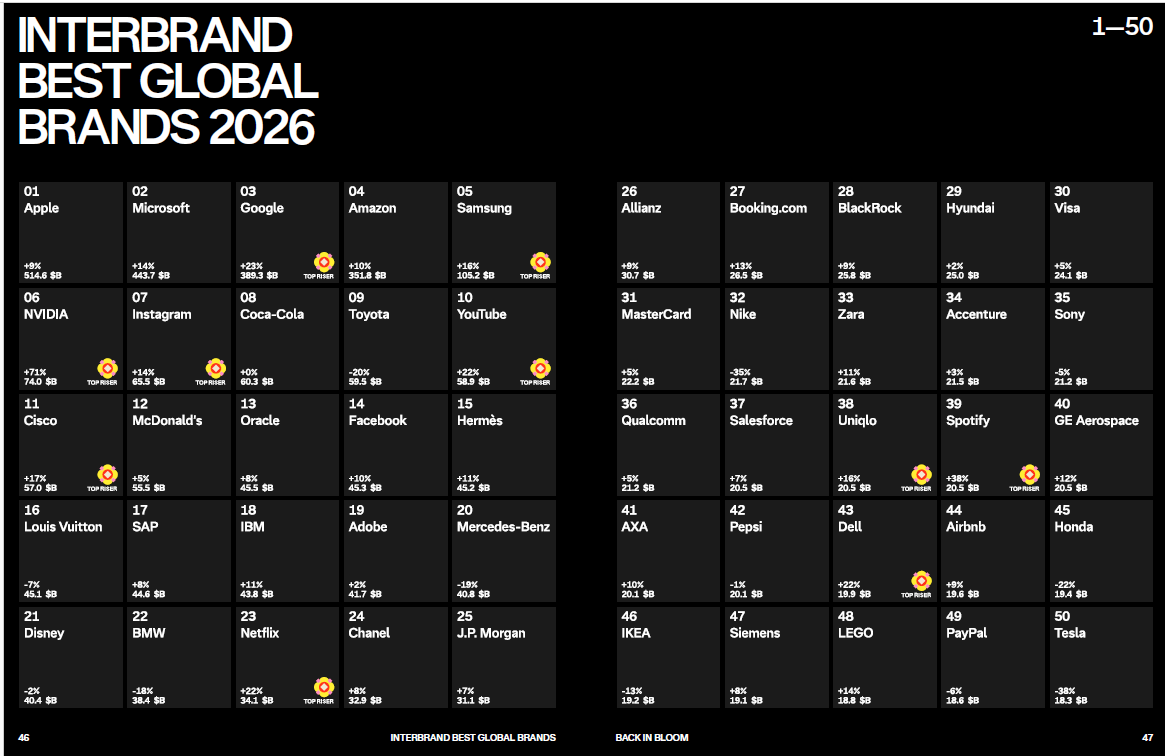
Probably because of this growing consumer pushback against AI-created ads, Coca-Cola is going back to human-created ads in its 2026 Holiday season “Enjoy Joy” spots, showcasing moments of connection and togetherness in a traditional manner. The brand ran AI-assisted ads during the last two years that, though they exceeded some internal benchmarks, proved divisive with consumers. Reported in: https://www.marketingdive.com/news/coca-cola-pivots-from-divisive-ai-generated-ads-for-holiday-campaign/875215/.
a. “Many AI systems rely on models and infrastructure that competitors can access on similar terms. As access becomes more common, differentiation may weaken and marketing outputs may become more similar across firms” (Liu, C., Wang, T., & Yang, S. A. (2025). Generative AI and content homogenization: The case of digital marketing. Available at SSRN 5367123).
b. “Delegation (of marketing tasks to AI) creates new responsibilities around the decisions the system performs. For example, a firm must translate its retention strategy into an objective the AI agent can pursue. Maximizing win-back conversion alone, for example, may encourage excessive discounting by the AI agent unless margin, customer value, and brand considerations are also incorporated. Employees must verify offers because errors in terms or voice may reach customers before aggregate measures reveal them.”
c. “When an AI agent performs previously-performed decisions, employees exercise the relevant judgment less often, reducing the human-employee practice that sustains the capability. The decline may remain hidden while the system performs well and experienced employees remain available. The organization may discover the loss only when effective oversight requires judgment that is no longer being regularly exercised.”
d. “AI adoption can change staffing and role content, but its economic consequences extend well beyond payroll. Marketing roles often contain judgment that is not captured in formal task descriptions, including knowledge of exceptions, customer responses, and the limits of established processes. When an AI system assumes part of a role, the firm must determine where that judgment will reside and who will govern the decisions now performed by the system. Continuing roles may therefore require substantial redesign, while responsibilities embedded in eliminated roles must be reassigned. Labor savings constitute economic benefit only after the analysis accounts for these continuing responsibilities and for any judgment lost through the reorganization.”
e. “Role redesign (bringing in AI into the system) also has a developmental consequence. Marketing judgment develops through repeated exposure to customers, campaigns, experiments, and decisions whose outcomes become observable over time. When AI assumes a substantial share of those decisions, employees lose some of the practice through which they prepare for more senior responsibilities.”
The selected text portions above are taken from: Return on AI (RoAI): A framework for assessing AI investments in the marketing organization, by V.K.Kanuri, A. Pattabhiramaiah and S.Sridhar, Journal of the Academy of Marketing Science, published online 21 October 2026, https://doi.org/10.1007/s11747-026-01217-6), which allows adaptation and distribution (if appropriately credited) under the terms of the Creative Commons license https://creativecommons.org/licenses/by/4.0/deed.en/.
Posted in Ch. 7: Strengthening Brands Using Digital Marketing and AI, Comments and Updates about the Book Overall | Tagged Use of AI in Branding | Leave a Comment »