
In October 2026 Interbrand released its latest Best Global Brands valuations and ranking. Screenshots are provided below from their Report, which can be downloaded from the Interbrand website. These two Tables below are reproduced here as a teaching accompaniment to Chapter 2 of the book, which already presents and discusses Interbrand rankings from earlier years, so these fresh Tables serve as an update. They are copyrighted by Interbrand and are reproduced here under “fair use” principles for classroom discussion (educational) purposes.
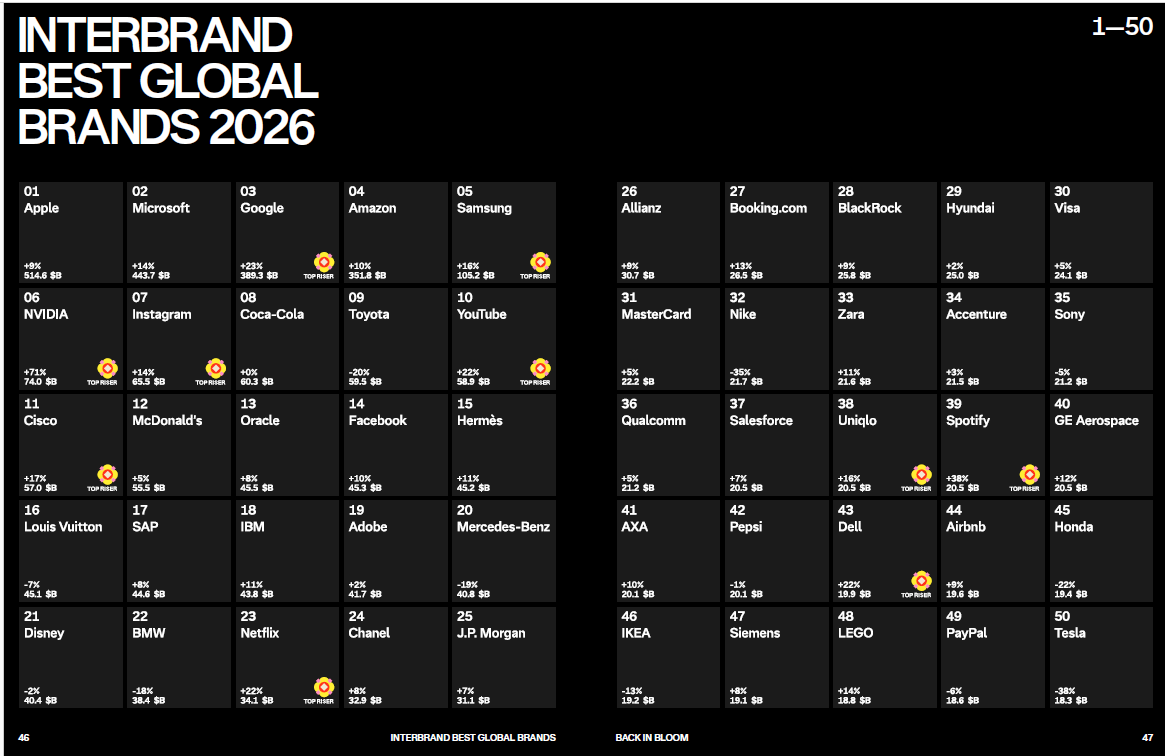
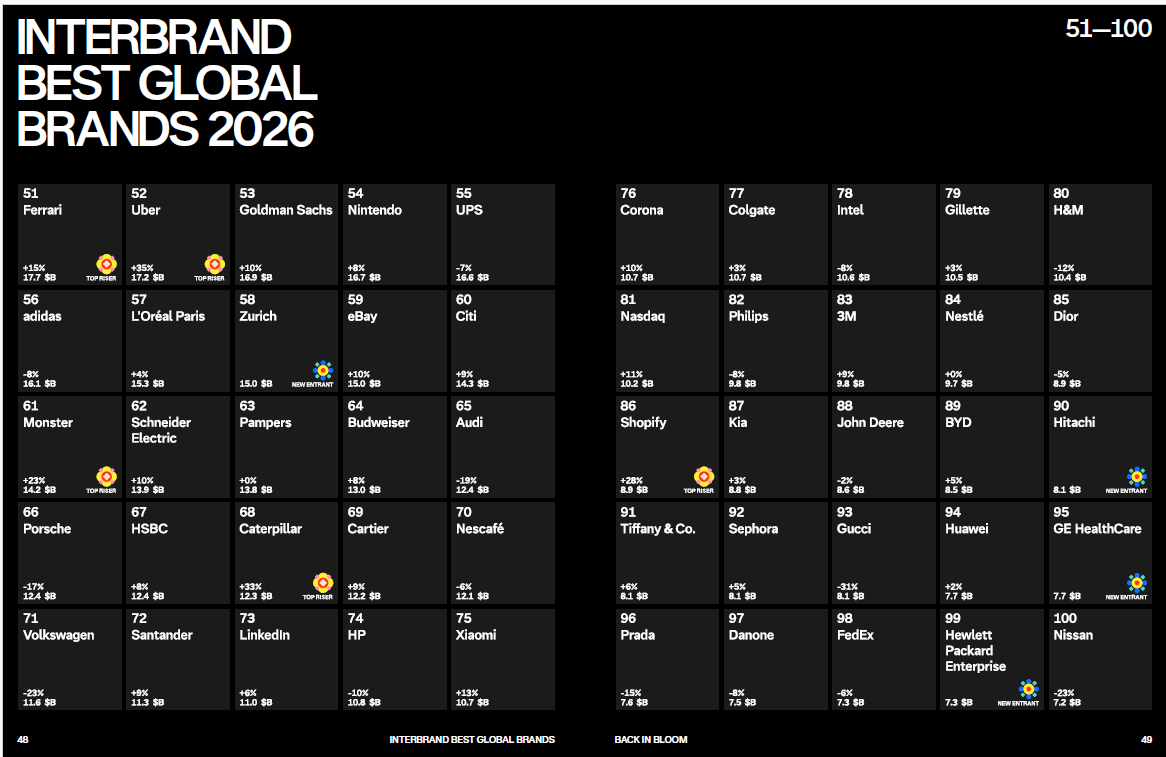
Not surprisingly, technology brands are very prominent, given their recent huge gains in stock market value (which is a key input into Interbrand’s brand valuation methodology, discussed in Chapter 14 of the book.). To quote the Report: “Technology brands now make up half of the top 10 and the category’s nine brands account for 48% of the ranking’s total value. NVIDIA’s brand value rose by more than 71%, making it this year’s fastest riser and one of the top 10 just two years after first joining the table.” There is not much change otherwise in the Top 10, though YouTube is now #10 from #13 last year, and McDonald’s dropped out of the top 10 (to #12).
It is interesting to see that Nike has dropped to #32 in 2026 from #23 in 2025, not surprising because of its recent product, market and financial difficulties, discussed in the opening of the book’s Chapter 2 and in a different update on this content-update blogsite. Nike’s fall vividly exemplifies the core idea in Chapter 2 of the book, that high perceived quality (which Nike is apparently not associated with these days, as it used to be in decades past) is a foundational brand association needed to become, and then remain as, a strong brand.


Nike Drop in Brand Strength Continues (Chapter 2)
November 20, 2026Chapter 2 of the book begins with the assertion that Nike, despite its prominence, is actually not that strong a brand these days, and gives financial evidence and leadership-change history as of late 2024, when that chapter was initially written. Readers will naturally wonder what the situation is today, as of late 2026. So here is an update, beginning with this striking graphic from a recent Bloomberg article (Nov 16, 2026, It’s Break-Up Time for Nike and Kim Kardashian, by Andrea Felsted):
Besides arguing that the recent NikeSkims smoothing and sculpting apparel line with Kim Kardashian is not one in which Nike should invest more time and money, the article strongly recommends that Nike CEO Elliott Hill (who was brought in in October 2024 to change the brand’s strategy) should continue to focus on Nike’s “struggling” “sport offense” strategy intended to strengthen Nike’s products’ ability to make its clothing and footwear buyers “run faster, play harder and lift heavier.”
Nike’s third-quarter 2026 financial results were met with negative reviews and downgrades by many. Barrons magazine (https://www.barrons.com/articles/nike-stock-price-downgrade-rating-42c113f3) reported analyst downgrades on its stock because of concerns about the company’s lack of innovation, not much excitement with its new product launches, a decline in North American wholesale revenue (in part due to ill-advised retail distribution changes), and weakening consumer demand in China. At that time in September 2026, Nike’s shares had fallen 44% this year having lost more than 50% of their value over the last 12 months, while the S&P 500 had climbed 13%. A Wall Street Journal (WSJ) article on October 1, 2026 (https://www.wsj.com/business/earnings/nike-projects-sales-decline-this-year-after-lower-first-quarter-revenue-3b845fa0) reported that Nike announced plans to shrink its operations and cut jobs to improve its financial results. It added that a key USA retailer, Dick’s Sporting Goods, was finding that sales of some of Nike’s classic shoes — such as Air Force 1 sneakers — had slowed. Nike’s own sales forecasts expected these sales declines to continue at least through May 2027.
China is the company’s second-largest market, where Nike’s revenue has declined almost 30% from its peak five years ago. (More commentary on Nike’s China problems is at: https://www.wsj.com/business/retail/the-nike-lifer-driving-a-high-stakes-turnaround-in-china-b7c9842e). While there are many reasons for this decline (including changes in retail distribution), one of them is the increasing perception among Chinese buyers that the brand’s quality and value now isn’t as good as Chinese rivals. “Plenty of domestic brands now offer superior technology at a fraction of the cost,” is one quote in this WSJ article on October 1, 2026. Chinese competitors like Anta (which also owns the Fila and Descente brands in China) and Li-Ning are now releasing new sneakers, with better technology and more-local style, at twice the speed of Nike — and at half the price.
There are also complaints in this WSJ October 1 article that Nike’s advertising in China uses messaging that is less relevant culturally, emphasizing winning and competitiveness while younger Chinese engage in sports just to get fit and hang out with friends (see Chapter 13 of the book for the need for locally-relevant brand communications).
Posted in Ch. 13: Global Branding, Ch. 2: Understanding Brand Strength, Comments and Updates about the Book Overall | Leave a Comment »